Guía completa para entrar en Arabia Saudita




Why This Conversation Matters Right Now
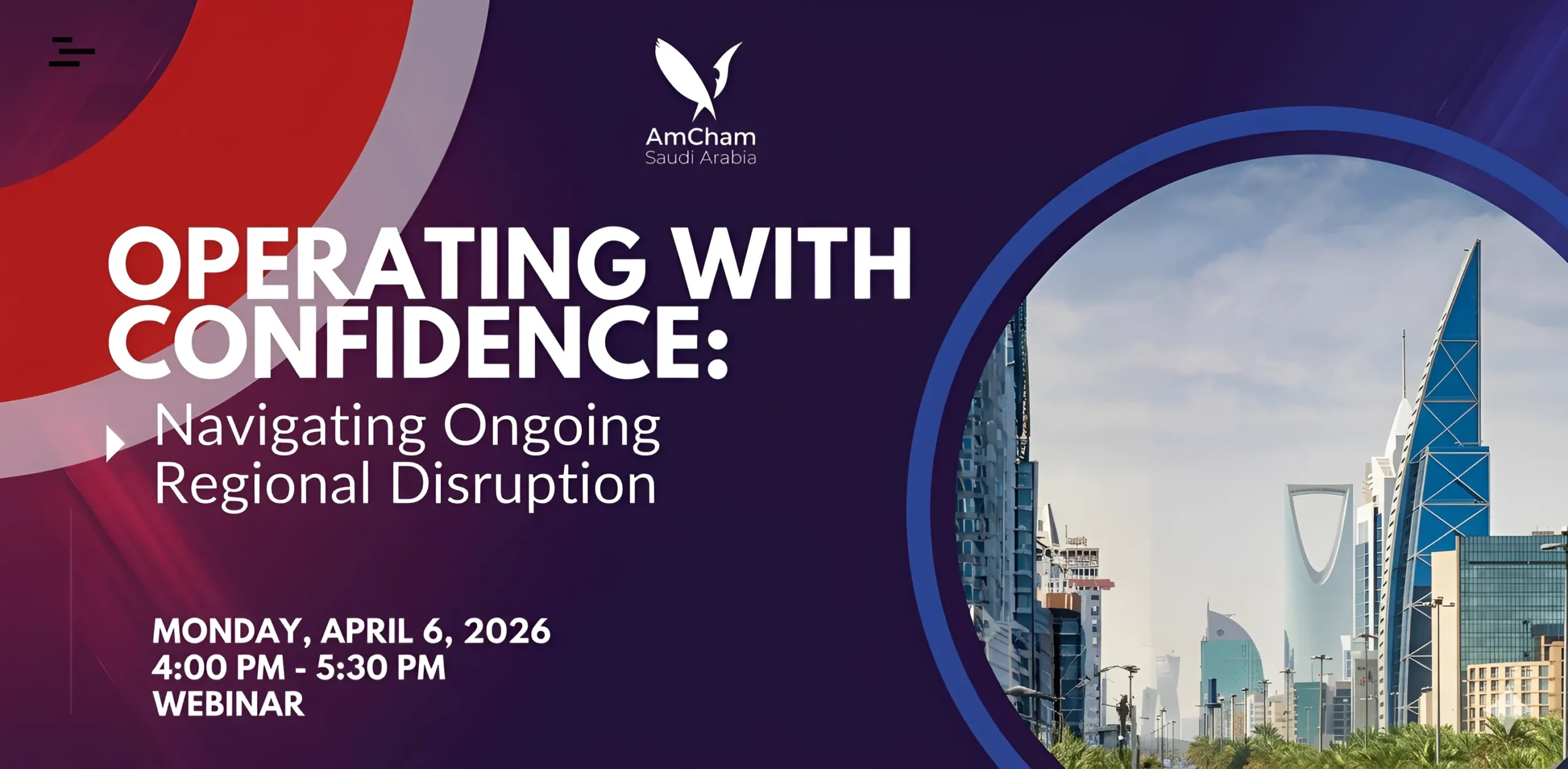
MENA Business Investment Group is proud to have participated in the recent American Chamber of Commerce Saudi Arabia (AmCham Saudi Arabia) webinar, “Operating with Confidence: Navigating Ongoing Disruption,” held on April 6, 2026.
For multinationals operating in the Kingdom, the past few years have made one truth impossible to ignore: business continuity in Saudi Arabia is not built in calm conditions, it is tested in disruptive ones. Whether the trigger is a regional event, a regulatory shift, or an internal crisis at a client’s global headquarters, the companies that keep operating smoothly through disruption are the ones that prepared for it long before it arrived.
That was the central theme of the AmCham Saudi Arabia webinar, and it is exactly why our team was glad to take part. The session brought together practitioners who deal with the operational realities of running a business in KSA every day, and the conversation cut quickly past theory into the specific pressure points that catch employers off guard.
MENA BIG on the Panel: Three Critical Exposure Points
Our Business Development Manager, Ahmad Abdallah, used his time on the panel to highlight three critical areas exposing businesses in KSA right now. Each of these areas looks routine on a normal day. Each of them turns into a serious vulnerability the moment something disrupts standard operations. The pattern matters: the issues that quietly accumulate during good times are the same ones that surface most painfully during bad times.
Below is a closer look at each of the three exposure points Ahmad raised, and why each one is worth a place on the agenda of any HR director, country manager, or COO operating in the Kingdom.
1. Payroll Continuity: WPS Will Not Wait for a Crisis
The first exposure point is one of the most consequential and one of the most underestimated: payroll. Specifically, the Wage Protection System (WPS), and the strict enforcement regime that surrounds it.
As Ahmad put it: WPS is strictly enforced during crises. Missed deadlines mean immediate fines and visa freezes.
That sentence deserves to be read twice, because it captures something many international HR leaders only learn the hard way. WPS does not relax its rules because a company is dealing with disruption at the same time. There is no informal grace period when a head office is distracted, a finance system is migrating, or a regional event is consuming everyone’s attention. The deadlines stand. The penalties stand. And the consequences, fines and, more disruptively, visa freezes, hit the entire operation, not just the payroll function that missed the cut-off.
For multinationals, the practical implication is that payroll continuity has to be designed as a separate, ring-fenced workstream. It cannot share resources or attention with whatever crisis the business is also navigating. The companies that learned this lesson before they needed it are the ones still paying their teams on time when their peers are scrambling.
2. Iqama & Mobility: Audit Before You Travel, Not After
The second exposure point is the documentation layer that sits underneath every expatriate employee in the Kingdom: iqamas, Muqeem extensions, and exit visas.
Ahmad’s guidance here was direct: proactively audit expiries, file Muqeem extensions, and verify exit visas before any employee travel.
The phrase “proactively audit” is doing a lot of work in that sentence. The most common mobility failure is not malice or even neglect, it is simply timing. An iqama that is technically valid this month becomes a problem the moment an employee tries to travel and discovers their documentation will expire mid-trip, or that a required extension was never actually filed, or that an exit visa assumption made at HQ does not match the in-Kingdom reality.
Treating mobility documentation as something checked at the airport is, in 2026, a recipe for stranded executives, cancelled meetings, and the kind of operational embarrassment that erodes trust in the local team. Treating it as a continuous audit, owned by someone, reviewed on a schedule, and verified before any travel, is what allows global teams to move with confidence.
3. Crisis Coordination: An Infrastructure Problem, Not a Communication One
The third exposure point Ahmad highlighted is the most strategic of the three. It is also the one that most often gets misdiagnosed: the disconnect between HQ and KSA operations is an infrastructure issue, solved only by having authorized, in-Kingdom PRO support.
This framing is important. When something goes wrong between a global headquarters and a Saudi operation during a crisis, the instinct is to treat it as a communication breakdown, to schedule more calls, send more updates, or tighten the reporting line. But the underlying issue is rarely about communication. It is about authority. Many critical actions in the Saudi system require a properly authorised, in-country PRO (Public Relations Officer / Government Relations Officer) who can interact with government platforms, ministries, and authorities in the way the system expects.
Without that authorised, in-Kingdom presence, even a perfectly coordinated HQ team simply cannot push the right buttons at the right moment. With it, decisions made overseas can be executed locally without the friction that turns small problems into big ones. That is why Ahmad described this as an infrastructure issue: it is built or not built before the crisis, not negotiated during it.
Our Commitment in Action
Talking about preparedness is one thing; demonstrating it is another. Our commitment in action is the part of the message we are most proud of: MENA BIG has already completed iqama audits for all clients, filed necessary extensions, and pre-staged payroll with zero WPS disruptions.
Each of those statements maps directly to one of the exposure points above. The iqama audits address the mobility risk before it materialises. The filed extensions ensure that documentation does not expire at the worst possible moment. And the pre-staged payroll, combined with zero WPS disruptions, means our clients have not had to choose between handling a crisis and paying their teams correctly. They have been able to do both, because the underlying infrastructure was already in place.
This is what “operating with confidence” actually looks like on the ground. Not promises. Not last-minute scrambles. Quiet, audited, in-Kingdom execution that holds up when conditions are anything but quiet.
A Thank You to AmCham Saudi Arabia
A sincere thank you to The American Chamber of Commerce Saudi Arabia (AmCham Saudi Arabia) for hosting this vital session. Conversations like this one are how the business community in the Kingdom collectively raises its standard of preparedness, and we were glad to contribute to it.
For any organisation reflecting on the three exposure points above, the takeaway is straightforward: payroll continuity, iqama and mobility, and crisis coordination are not problems to solve when something goes wrong. They are infrastructure to build before anything does. The companies that already have it in place are the ones still operating with confidence, exactly as the webinar’s title suggests.